
Streamline your financial workflows with a general ledger built for scaling tech companies. Automate reporting, close faster, and keep your team focused on what matters most.
Explore Campfire’s Core Features
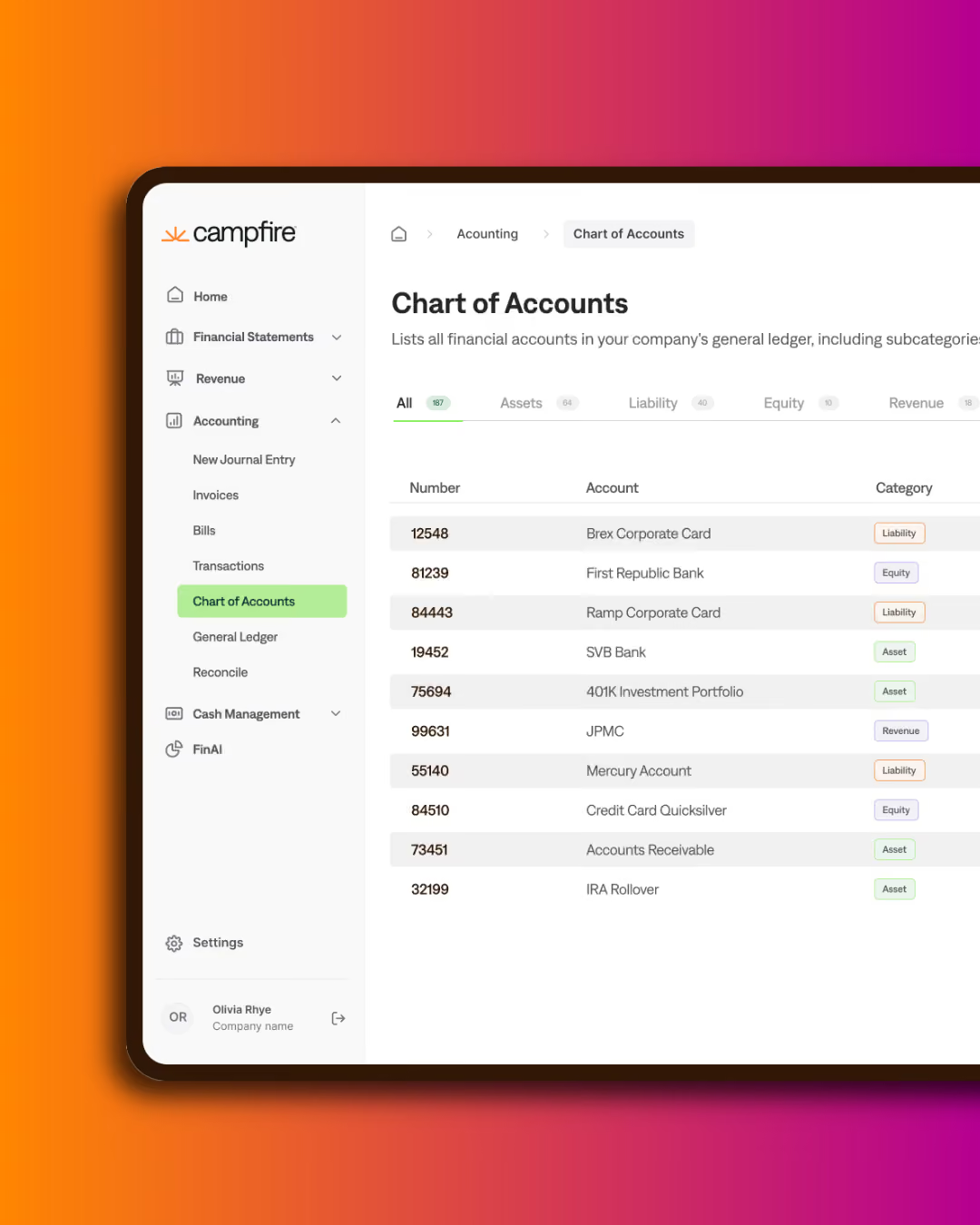
Key features include multi-dimensional chart of accounts with unlimited segments and hierarchies, automated journal entry creation and approval workflows, real time sub-ledger reconciliation and balance verification, comprehensive financial statement generation, ad hoc reporting with drag and drop builders, intercompany transaction processing and elimination, multi-currency and multi-entity support, complete audit trail with drill down capabilities, AI-powered anomaly detection and insight surfacing, and configurable period management with flexible close processes.
Close management turns the month-end close from a loose checklist into a controlled process. Teams can assign tasks, set due dates, require approvals, and monitor progress in one place. That removes a lot of follow-up work and helps everyone stay aligned. It also reduces the risk that something gets missed because a step lived in someone’s personal spreadsheet. For larger teams, this creates much more consistency across entities and close cycles., Reconciliation tools give teams one place to match balances, track open items, and store support. Instead of emailing files back and forth, users can work inside a shared workflow with status, ownership, and history. Auto-matching handles the straightforward items, while exceptions rise to the top for review. That makes the process easier to manage and much easier to audit. It also gives leadership a live view of what is done and what is still open., Approval workflows and segregation of duties help companies keep financial control as the team grows. The system can route work to the right reviewer and prevent one person from doing everything end to end. That lowers fraud risk and reduces the chance of simple mistakes going unchecked. It also creates a more defensible process for audit and compliance work. This is foundational for teams that want strong controls without heavy manual policing., Recurring journal automation takes entries that repeat each month and turns them into controlled templates or schedules. That means teams do not need to recreate the same work again and again. It also lowers the chance of forgetting an entry or posting it differently from the prior month. Review becomes easier because the logic stays consistent. This is one of the clearest ways to save time in routine close work., A strong audit trail shows who changed what, when they changed it, and what the prior version looked like. That gives finance teams confidence that important records are traceable and defensible. It also removes a lot of pain during audit requests because the history is already there. Instead of trying to reconstruct decisions from email threads, teams can point to one clear record. That improves trust in the numbers and in the process behind them.
Fixed asset management tracks the life of an asset from purchase through depreciation and retirement. That gives finance one place to manage asset records, methods, useful lives, and supporting documents. It removes the need for separate trackers that can drift out of sync with the books. It also makes periodic depreciation easier to automate and review. This improves both operational efficiency and reporting quality., Recurring journal automation takes entries that repeat each month and turns them into controlled templates or schedules. That means teams do not need to recreate the same work again and again. It also lowers the chance of forgetting an entry or posting it differently from the prior month. Review becomes easier because the logic stays consistent. This is one of the clearest ways to save time in routine close work., A strong audit trail shows who changed what, when they changed it, and what the prior version looked like. That gives finance teams confidence that important records are traceable and defensible. It also removes a lot of pain during audit requests because the history is already there. Instead of trying to reconstruct decisions from email threads, teams can point to one clear record. That improves trust in the numbers and in the process behind them., A custom report builder lets finance teams create the views they need without waiting on technical support each time. That makes reporting more responsive to how the business actually operates. Teams can build board views, department views, and operational views from the same source data. It also cuts down on one-off spreadsheet work that quickly gets hard to maintain. This helps finance move faster without losing control.
Campfire's Audit & Controls module reduces audit preparation time by up to 70% by automating evidence collection, maintaining immutable version histories, and enforcing compliance policies in real time. Finance teams spend less time on manual documentation and more time on strategic analysis, while external auditors gain direct access to structured audit trails that satisfy SOC 2, ATO, and ASIC requirements. The result is faster close cycles, fewer compliance findings, and a finance function that scales without proportional headcount increases.
Eliminate manual data entry between systems by 95 percent, reduce integration implementation timelines from months to days with prebuilt connectors, achieve real time data synchronisation across your entire technology stack, enable custom workflow automation through over 100 API endpoints, and ensure complete data consistency between financial and operational systems while scaling seamlessly as your organisation grows.
Campfire's Budgeting & Forecasting module reduces planning cycle times by up to 60% while improving forecast accuracy through AI powered projections and real time data integration. Finance teams eliminate manual spreadsheet reconciliation, gain instant budget versus actual visibility, and produce board ready scenario analyses in hours rather than days. The collaborative approach increases organisational alignment around financial targets and gives leadership confidence in the numbers behind every strategic decision.
Reduce consolidation close time by up to 80%, eliminate manual reconciliation errors, ensure continuous compliance with AASB standards, and provide leadership with real time visibility into group financial performance across all entities and jurisdictions.
Eliminate manual currency conversion errors, reduce entity onboarding time by 70%, maintain continuous regulatory compliance across all jurisdictions, and gain unified real time financial visibility across your entire global corporate group.
Reduce invoice processing time by 85%, accelerate payment collection by up to 40%, eliminate billing errors and revenue leakage, and gain real time visibility into billing performance and cash flow forecasting across all revenue streams.
Eliminate revenue recognition errors and restatement risk, reduce close cycle time for revenue reporting by up to 75%, ensure continuous AASB 15 compliance, and provide leadership with accurate forward looking revenue forecasts based on real contract data.
Improves visibility, speeds analysis, reduces reporting effort, and supports better decisions.
Improves cash visibility, supports better planning, and reduces liquidity risk.
Reduces manual tracking, improves depreciation accuracy, and supports compliance.
Shortens close cycles, improves accountability, and reduces process risk.
Eliminate revenue leakage from missed renewals and billing errors, reduce contract processing time by up to 70%, improve compliance with contract obligations, and gain real time visibility into contract performance and financial commitments across your entire portfolio.
Reduce days sales outstanding by up to 30%, achieve over 95% cash application accuracy, lower bad debt write offs, and forecast cash inflows with AI driven receivables analytics.
Reduce invoice processing costs by up to 80 percent, capture more early payment discounts, eliminate duplicate payments, and gain real time visibility into payables obligations and cash flow requirements across your entire vendor portfolio.
Reduce manual data entry by up to 90 percent, accelerate financial close cycles by 50 percent, detect anomalies and potential fraud in real time, improve forecast accuracy by 40 percent, and free finance teams to focus on strategic analysis rather than routine processing tasks across every area of financial operations.
Eliminate manual reconciliation effort by 80 percent, reduce journal entry processing time by 70 percent, achieve real time financial visibility across all entities, accelerate period end close by days, and ensure complete audit trail compliance while supporting unlimited account dimensions and reporting hierarchies for organisations of any complexity.