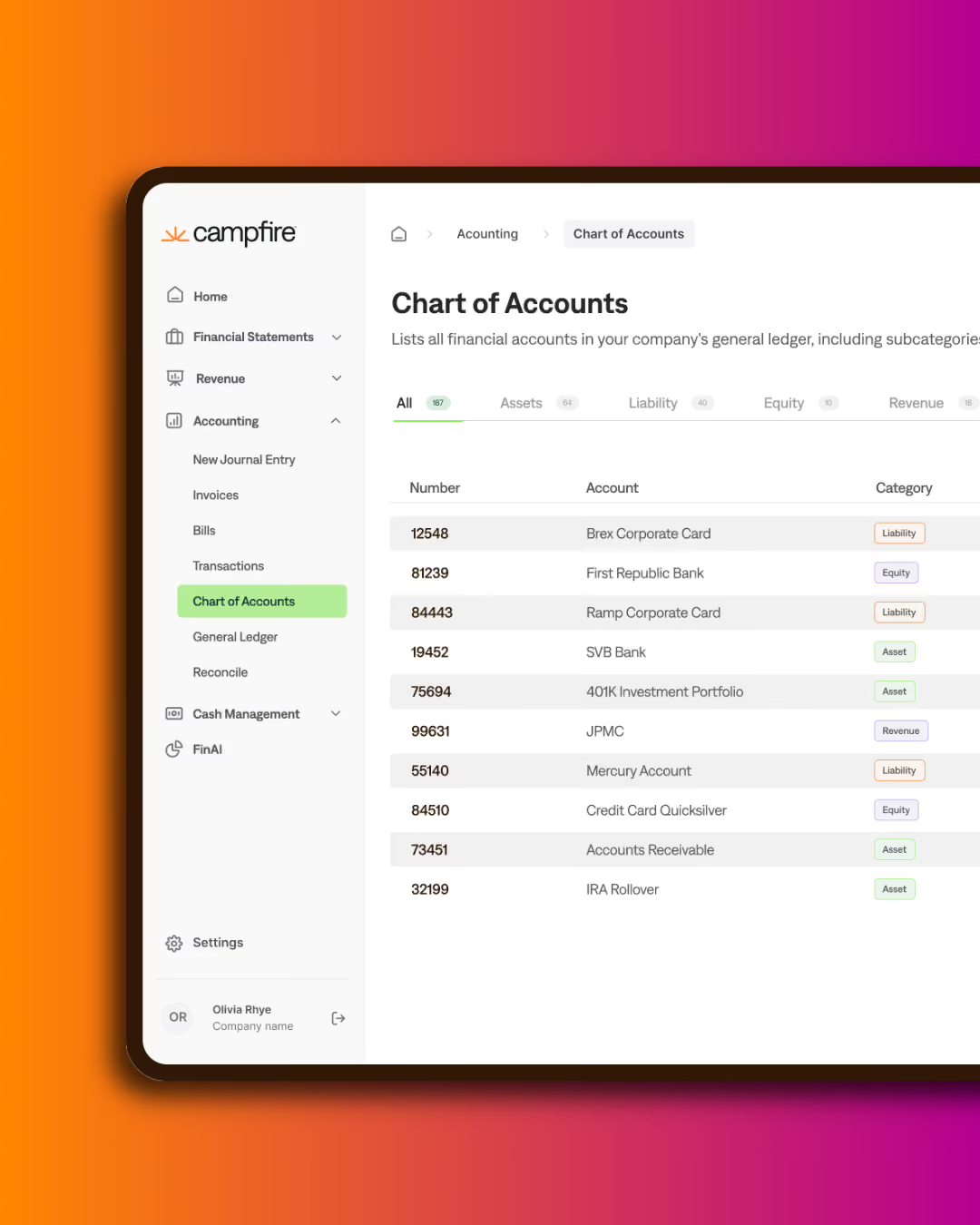
Campfire.ai is built to integrate. Native connections to the systems your business already uses — CRMs, billing platforms, spend management, payroll, banking — flow data directly into the general ledger, eliminating duplicate entry and manual reconciliation.
Cynder is the partner that designs and configures those integrations correctly. We map your data flows, align your chart of accounts to incoming records, and make sure the connections work the way your finance team expects them to from day one.
The goal is simple: the data your business creates everywhere else should land in your books automatically, accurately, and audit-ready.
Book a Campfire Fit Assessment
Campfire ships with native integrations to the platforms most commonly found in high-growth tech companies. Cynder configures them to your business model and ensures the data flowing through them maps cleanly to your accounting structure.
CRM and Revenue. Salesforce and HubSpot connect contract data, deal stages, and billing schedules directly to Campfire's revenue engine — automating ASC 606 revenue recognition, ARR waterfalls, and contract-level reporting.
Billing and Payments. Stripe integration unifies payment status, invoice data, and revenue records, allowing accounting teams to manage end-to-end revenue without exporting between systems.
Spend and Cards. Ramp and Brex push transaction data, card spend, and bill payments straight into the general ledger, removing the manual coding step that consumes finance team time at month-end.
Payroll and HRIS. Rippling syncs payroll, headcount, and people-cost data into Campfire — automatically allocating expenses to the right departments and entities.
Banking. Direct banking connections support automated reconciliation, removing one of the most time-consuming components of the monthly close.
Treasury and Cash Management. Rho and similar treasury platforms feed cash position and transfer data into Campfire for real-time visibility.
A native integration is only as good as the configuration behind it. Plugged in without thought, it creates noise. Configured properly, it removes work permanently.
A Cynder-configured integration delivers:
Campfire's unified connection layer supports custom integrations to systems beyond the native list — internal tools, billing engines, usage-based platforms like Orb or Metronome, tax engines like Anrok or Avalara, and bespoke data sources unique to your business.
Cynder builds and configures these custom connections where the native catalogue doesn't reach. We work with Campfire's developer APIs to deliver integrations that are reliable, documented, and maintainable — not brittle scripts that break six months after go-live.
If your finance stack includes a system Campfire doesn't natively support, we'll scope the integration during discovery and confirm what's possible before any work begins.
Integration work happens in parallel with the broader implementation, but we treat it as a discrete workstream because the failure modes are specific.
We map every data flow at the field level — what comes in, where it lands, how it's categorised, and what triggers automated postings. This document becomes part of your audit trail.
We configure each integration in a sandboxed environment first, validating data flow against test transactions before connecting to live systems.
Once connected, we reconcile incoming data against source systems for at least one full close cycle. Discrepancies are resolved before cutover, not after.
Your finance team receives written documentation of every integration: what it does, what it touches, how to troubleshoot it, and how to extend it. The platform belongs to you when we're done.
A 30-minute discovery conversation will tell you: