Streamline your financial workflows with a general ledger built for scaling tech companies. Automate reporting, close faster, and keep your team focused on what matters most.
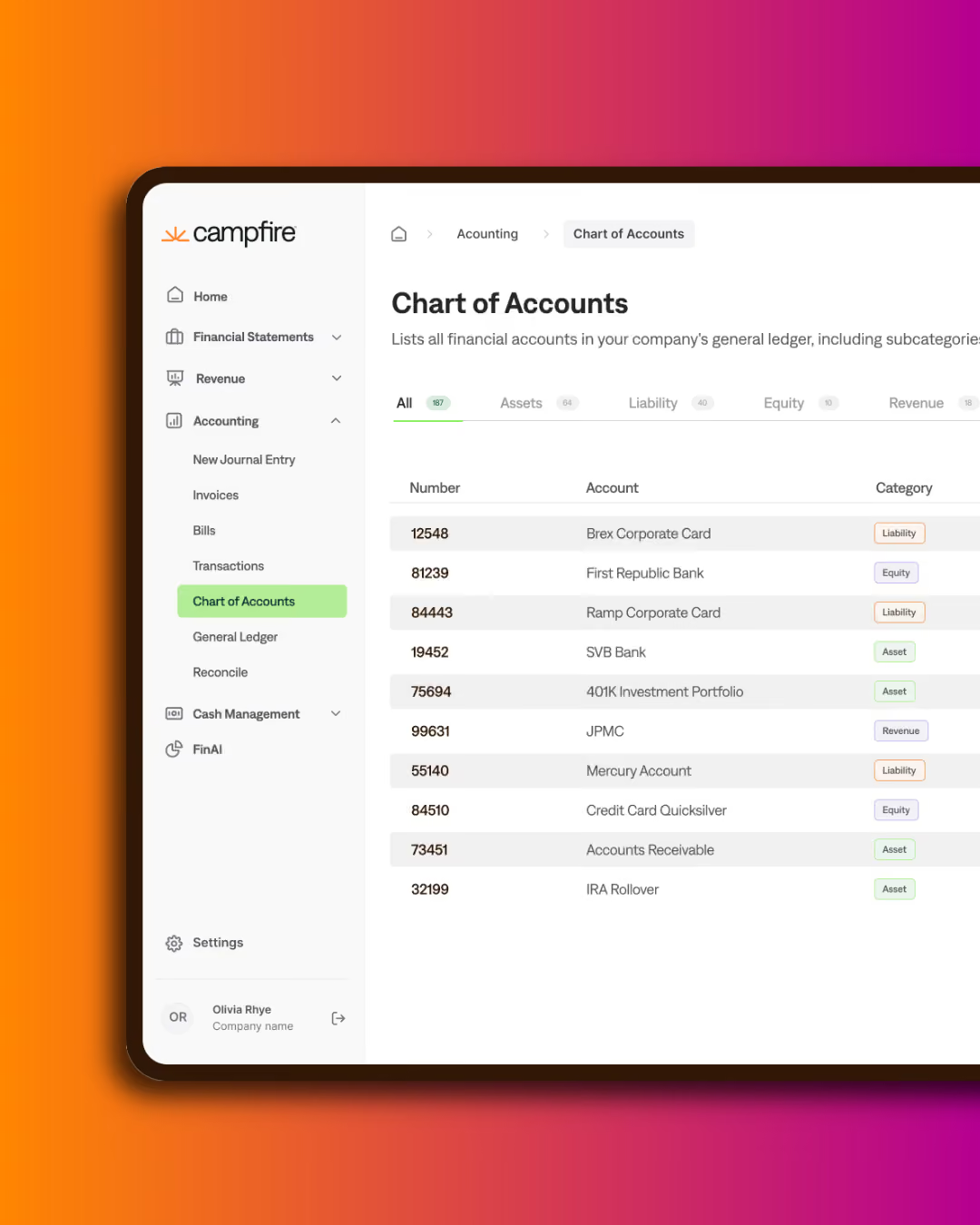
Discover how Campfire streamlines your financial workflows and empowers your team with clarity and control.
Campfire uses AI to read and interpret contracts in any format, including PDFs, Word files, scanned documents, and email attachments. It identifies and structures key commercial terms such as contract value, payment schedules, pricing tiers, service levels, liability limits, and renewal conditions. There is no need for manual templates, as the system adapts to different document styles. Extracted data is checked against business rules and existing records, with any inconsistencies or missing details flagged for review. This gives finance teams fast access to accurate contract data without manual extraction.
Campfire’s extraction engine improves over time by learning from user corrections and validations. It builds an understanding of how contracts are written within your organisation, increasing accuracy with continued use. Teams can upload large volumes of contracts to digitise legacy archives quickly, turning static documents into structured, searchable data. Each extracted field includes a confidence score, allowing reviewers to focus only on areas that need attention while letting high-confidence data move forward automatically. This reduces review time while maintaining data quality.
Campfire connects extracted contract data directly to billing, revenue recognition, and accounts payable processes. Key financial terms such as payment milestones and billing triggers are identified within the contract and used to create the relevant records automatically. This removes the need for manual data entry between contract signing and financial execution. The system also highlights unusual or non-standard terms, helping teams assess risk across the contract portfolio. With structured contract data feeding into financial systems, businesses can operate with greater accuracy and control.
Campfire manages contract changes by detecting updates to agreements and recalculating revenue recognition schedules automatically. When contracts are renewed, expanded, reduced, or ended early, the system assesses how the change should be treated under accounting standards. It reallocates transaction prices across remaining obligations and applies any required adjustments to keep reporting accurate. This removes the need for manual recalculations and helps ensure revenue reflects the current contract terms at all times.
Campfire evaluates each modification to determine the correct accounting treatment. It assesses whether added goods or services are distinct and whether pricing aligns with standalone selling prices. Based on this, the system decides whether to treat the change as a separate contract or as part of the original agreement. For forward-looking changes, new revenue schedules are created from the effective date. Where required, cumulative catch-up adjustments are calculated to align previously recognised revenue with the updated contract structure.
Campfire keeps a complete record of every contract modification, linking each version back to the original agreement. It tracks key details such as effective dates, pricing changes, and the impact on revenue schedules. This creates a clear audit trail that supports compliance with standards such as ASC 606 and IFRS 15. Auditors and finance teams can review how each change was assessed and applied, ensuring transparency and consistency across reporting periods.
Campfire manages contracts from initial draft through negotiation, active use, renewal, and eventual expiry or termination. Each contract moves through defined lifecycle stages based on events such as signing, effective dates, or milestone completion. These transitions happen automatically using configurable workflows, keeping progress consistent across all agreements. Lifecycle dashboards show the status of every contract in one place, helping teams see what is active, what is upcoming, and where attention is needed. This provides a clear, structured view of contract activity across the entire portfolio.
Campfire triggers actions at each lifecycle stage, including notifications, compliance checks, billing activation, and revenue recognition updates. Different contract types can follow their own lifecycle templates, with tailored stages and transition rules. Controls can be applied at each stage to require approvals, mandatory data, or supporting documents before a contract progresses. This ensures contracts move forward only when all requirements are met. By automating these steps, teams reduce manual oversight and maintain consistent governance across all agreements.
Campfire provides analytics that highlight where contracts slow down, such as stages with longer approval times or repeated delays. Reporting shows the value and volume of contracts at each stage, giving leadership a clear view of commitments and upcoming obligations. Historical data allows teams to track processing times, renewal rates, and outcomes over time. This helps identify areas for improvement and supports more efficient contract management. With better insight into lifecycle performance, teams can refine processes and maintain stronger control over contract activity.
Campfire manages the full recurring billing cycle, generating and sending invoices on schedule without manual input. It supports a wide range of billing frequencies, including weekly, monthly, quarterly, semi-annual, and annual cycles, along with custom schedules for more complex arrangements. As contracts change, the system updates future billing runs to reflect new pricing, renewals, or revised terms. This ensures invoices always match the current agreement. By automating the process, finance teams can maintain consistent billing across all customers without relying on manual tracking or intervention.
Campfire manages upgrades, downgrades, and cancellations by calculating pro-rata adjustments automatically. Credits or additional charges are applied to the next invoice, keeping billing fair and accurate. Teams can align billing schedules to calendar dates, contract anniversaries, or custom periods to suit each customer. The system supports advance billing, arrears billing, and mixed approaches, allowing flexibility across different contract types. This removes the need for manual calculations and helps ensure billing remains correct even when customer arrangements change during a billing cycle.
Campfire reduces the risk of missed invoices by automating recurring billing across subscription and retainer customers. Each invoice is checked against the active contract before it is issued, helping identify pricing issues, expired terms, or pending changes early. This improves billing accuracy and reduces disputes. Recurring billing data feeds into forecasting tools, giving finance teams a clearer view of expected revenue over time. With reliable billing and stronger visibility, businesses can plan ahead with greater confidence and maintain steady income streams.
Campfire connects invoicing to project progress by generating invoices automatically when milestones are completed or key project events occur. Contract billing schedules are mapped to project phases, ensuring each trigger produces the correct invoice amount, line items, and payment terms. This removes the gap between delivery and billing, so revenue is recognised at the right time. Project managers and finance teams work from the same view, with clear visibility of what has been delivered and what has been billed. This alignment helps prevent missed invoices and keeps billing consistent with contract terms.
Campfire allows teams to define billing triggers based on client sign-off, deliverable acceptance, percentage completion, or custom project events. The system calculates invoice amounts automatically, including retention, progress claims, and approved variations, while applying the correct tax treatment. Notifications alert project managers as billing points approach, helping ensure invoices are not delayed. This keeps billing aligned with actual project activity and reduces the risk of revenue slipping through gaps in communication or timing.
Campfire provides real-time dashboards that link project status with billing and revenue data. Teams can see which milestones have been invoiced, what is still pending, and where delays are building. This helps finance teams forecast upcoming invoice volumes based on project timelines, supporting better cash flow planning. Each invoice is tied back to the milestone, deliverable, and contract terms that triggered it, creating a clear audit trail. This level of visibility supports accurate reporting and makes it easier to respond to client queries about billing.